
The humpback whale season
Every southern winter, humpback whales travel north to the Mascarenes to calve and mate. Off Mauritius, they are watched for from July to November, while the sperm whales never leave the west coast at all.
August 5, 2026
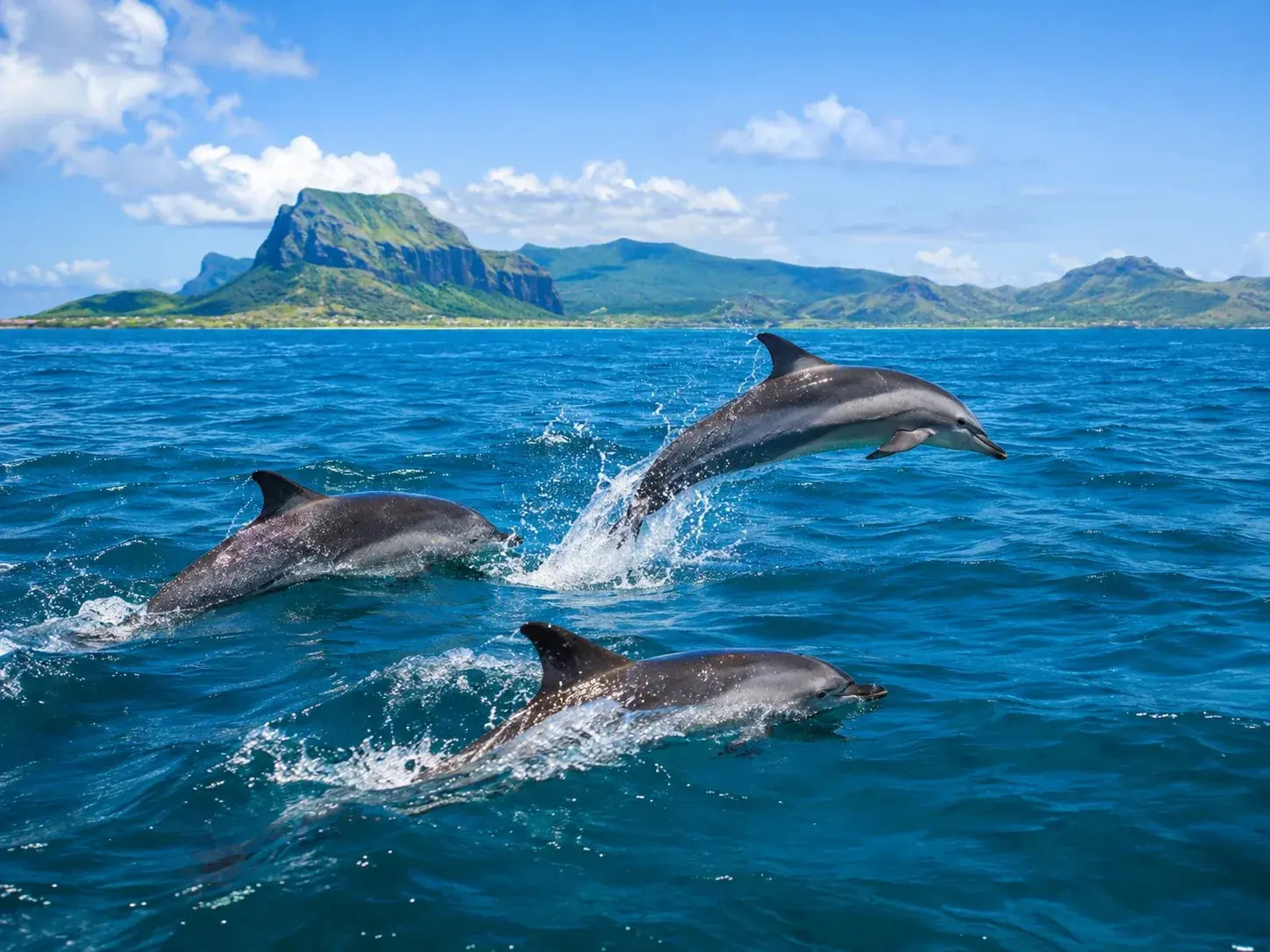 AI-generated image
There are two kinds of whale off Mauritius, and they do not keep the same calendar. Sperm whales are there all year round. Humpbacks pass through: they are seen from July to November, for the length of their migration. In both cases, the west coast offers the best chances, and it is around Black River, Flic en Flac and Le Morne that the trips are concentrated.
A journey from the Southern Ocean
The humpbacks that cruise around Mauritius belong to a population that shuttles every year between two worlds. In summer, they feed in the productive waters of the Southern Ocean. When winter comes, they head north to warmer waters, off East Africa, the Comoros, Madagascar and the Mascarenes, to breed. The International Whaling Commission places those of the Mascarenes in a sub-group it designates by the code C4.
Between July and October, the Mascarenes thus host whales that give birth, nurse their young and mate. Réunion is the best-known site of this winter stay: newborn calves are seen there, as are competing groups of males, and song is recorded. Mauritius and Rodrigues are visited too, but the distribution of whales around these two islands remains less well understood.
The clues are mounting nonetheless. Off the north-west coast of Mauritius, the presence of large males over twelve metres long and of females with calves points to a breeding area. Further out, in the open ocean, the La Pérouse seamount and the shoals of Saint Brandon have recently been recognised as breeding grounds in their own right. Males move from one site to another within a single season, no doubt to improve their chances: Réunion, La Pérouse, Saint Brandon and Mauritius form a single whole.
The sperm whales of the west coast
The sperm whale is the other giant of these waters, and it is no visitor. The underwater slope running along the west and south-west of Mauritius is among the main areas where the species breeds and feeds in the south-western Indian Ocean. The groups seen off Mauritius are mostly females and their young; adult males are rare there.
Between 2008 and 2013, 101 sperm whales were individually identified off the west coast. Among them, nineteen residents, in three social units, returned from one year to the next and remained faithful to the site for six years. Others were seen only once, a sign that some individuals range over a far wider area. Satellite tracking has shown movements from Mauritius to La Pérouse and Réunion in the west, and to Rodrigues in the east. The species is listed as vulnerable on the global Red List of Threatened Species.
These waters are rich beyond these two giants: twenty-two species of cetacean frequent the area formed by Mauritius, Réunion, La Pérouse and Saint Brandon, and fourteen have been seen off Mauritius. Because the slopes drop away quickly around oceanic islands, open-ocean species can be seen less than five nautical miles from the coast: in Mauritius, these include pilot whales.
The rules of approach
Commercial whale watching is governed by the same regulations as dolphin watching, in force since 1 November 2012, with the distances doubled. No boat may come within 100 metres of the nearest whale. From 100 to 200 metres lies a restricted zone, where boats move at no-wake speed, enter and leave at that pace, and where no sudden change of speed or direction is allowed.
The boat approaches the animal from the side and keeps a course parallel to its own. It comes neither from behind nor head-on, does not circle, never cuts through a group, and stays in neutral when stopped. It displays the Tourism Authority label and a propeller guard, and its skipper holds a certificate obtained after an examination on cetaceans and on how to behave in their presence.
One difference from the dolphins is worth knowing before boarding. Under certain conditions, you may swim near dolphins; you never swim, dive or snorkel with a whale. Commercial watching takes place between six in the morning and noon, and no one may knowingly kitesurf, ride a jet ski, paraglide, dive or windsurf within 500 metres of a whale. Finally, it is forbidden to feed one, touch one or make a noise to attract it.
 AI-generated image
Going to meet them
Whale-watching trips are concentrated on the west coast. They can be found at Black River and Flic en Flac, shared or reserved for a single group, sometimes with hotel pick-up. At Le Morne, some boats combine whales and dolphins in the same morning.
The essential point remains: on any given day, the presence of whales cannot be ordered up. July opens the season, November closes it, and in between, every trip is a chance, not a promise. The best way to take it is to set out early, on a licensed boat, and to leave the animal the distance the law reserves for it.
To book
Things to do from this article
- Book on GetYourGuide →
Dolphins and whales · La Gaulette
Private cruise: dolphins, turtles and rays - Book on GetYourGuide →
Dolphins and whales · Flic en Flac
Private excursion: dolphins, sea turtles and Île aux Bénitiers - Book on GetYourGuide →
Dolphins and whales · Flic-en-Flac
Private whale-watching excursion, with pick-up - Book on GetYourGuide →
Dolphins and whales · Le Morne
Le Morne: eco-friendly dolphin-watching trip - Book on GetYourGuide →
Dolphins and whales · Le Morne
Lydia Boat, Le Morne: eco-friendly whale and dolphin-watching trip - Book on GetYourGuide →
Dolphins and whales · Rivière Noire
Whale watching for a private group, Black River
Read next
 AI-generated image
A day on a catamaran
 AI-generated image
The lagoon and its coloured buoys
- AI-generated image
Blue Bay, the coral garden of the south-east
Where to stay
Stay in Mauritius
Places to stay that are still available, with current prices, compared across the main booking platforms.