The lagoon and its coloured buoys
In a Mauritian marine park, the colour of a buoy is anything but decorative: it tells you where to swim, where boats pass and where not to go. A reading of the lagoon, zone by zone, from Blue Bay to Balaclava.
November 3, 2026
 AI-generated image
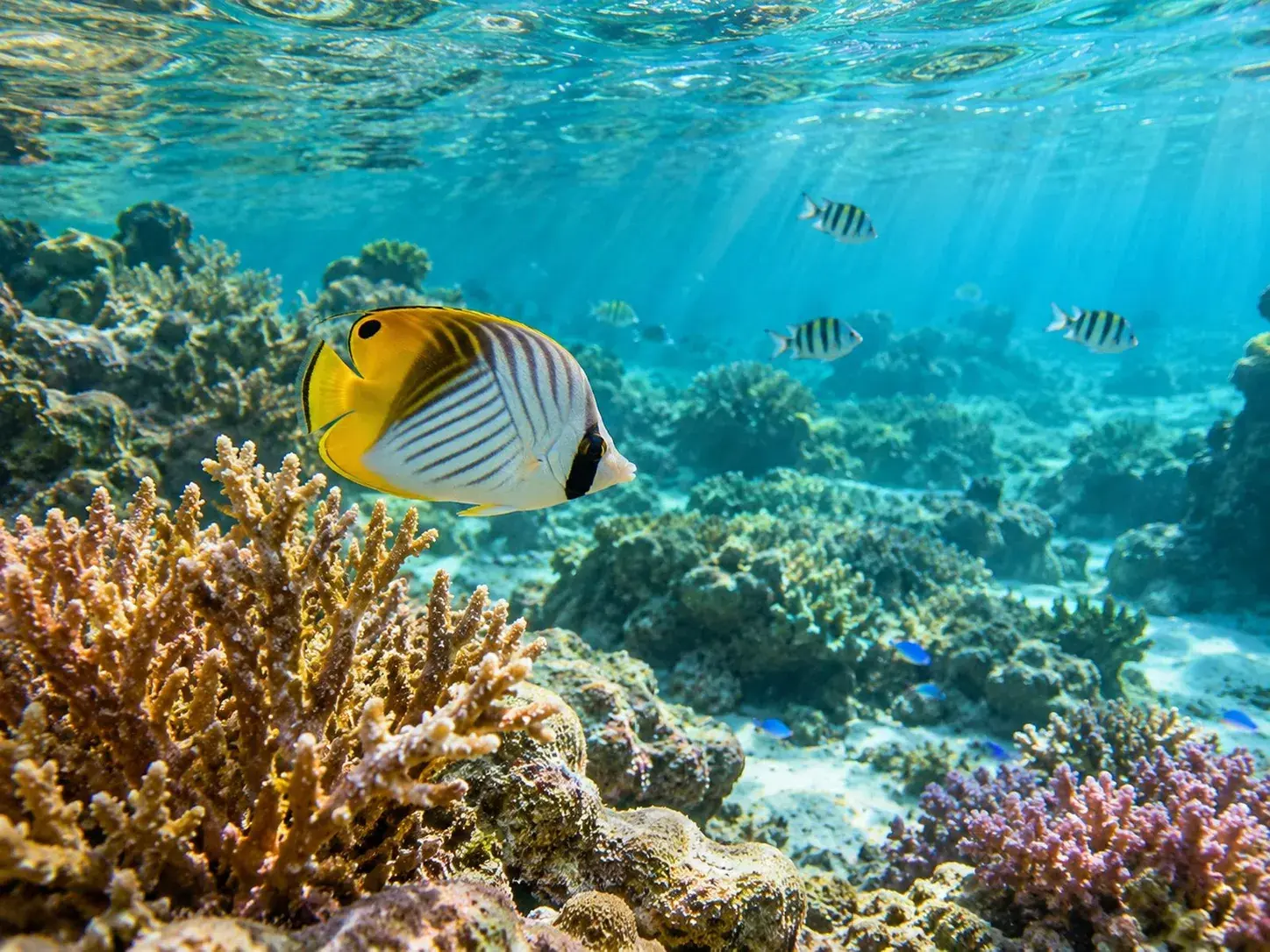
The Mauritian lagoon is not a free-for-all. Part of it is protected, divided into zones and marked out with buoys of different colours, and each colour stands for specific rights and prohibitions. The text that governs all this is the Marine Protected Areas Regulations of 2001, made under the Fisheries and Marine Resources Act 1998 and amended in 2007.
Three designations, seven zones, five colours
A marine protected area may be a fishing reserve, a marine park or a marine reserve. The three are not interchangeable, and the strictest prohibitions apply to the latter two.
A marine park is made up of zones, which may be a multiple use zone, a conservation zone, a strict conservation zone, a navigation channel, a ski lane, a mooring zone or a swimming zone.
The markings follow, and this is the part every swimmer would do well to know. Conservation and strict conservation zones are marked out by green buoys or floats. A navigation channel is marked by white buoys with vertical red stripes, a ski lane by orange buoys, a mooring zone by white mooring buoys. A swimming zone, finally, is bounded on its seaward side by a line of yellow floats and buoys.
What requires a permit
The list is both short and broad. In a marine park or a marine reserve, no one may, without a permit, take or kill marine flora or fauna, fish, feed marine fauna, have fishing gear in their possession, or carry out research or survey work. No one may conduct any commercial activity there without a permit, nor take photographs or shoot film there for commercial purposes.
For boats, the starting rule is a prohibition: the person in charge of a vessel may not bring it into a marine park or marine reserve without holding a permit for it. Once entry is authorised, the vessel must not use any passage other than the one provided for entry, exceed the speed limits of the zone, drop anchor anywhere other than in a mooring zone, or discharge waste from its toilets.
Speeds are measured in knots, with a second condition that is often forgotten. In a conservation zone, a strict conservation zone, a navigation channel and a mooring zone, a vessel must not exceed three knots, nor move at a speed that creates a wash or a wake.
In every marine protected area, further prohibitions apply whatever the zone: no building or placing of any structure, and no digging, removing or moving of sand, mud, rock, rubble or any other natural substance, without a permit; no dumping of waste or polluting substances; no damaging or marking of flora, fauna, rock or installations.
The lagoon from the swimmer’s side
In a swimming zone, no vessel is allowed, powered or not, any more than a pedalo, a kayak or a board, and fishing is prohibited. Conversely, and this is the rule most often overlooked, no one may swim anywhere in a marine protected area other than in a swimming zone.
In a navigation channel, swimming, snorkelling, diving and fishing are prohibited. In a ski lane, fishing is prohibited, water-skiing is allowed only with a permit and according to a timetable set by the authorities, and no one may swim or dive there while skiing is in progress.
No one enters a conservation zone or a strict conservation zone without a permit, and all forms of fishing are prohibited there, save for a few named exceptions. In a multiple use zone, fishing is permitted only by line and by trap, unless under permit.
 AI-generated image
Blue Bay and Balaclava
The two marine parks of Blue Bay and Balaclava each have their own boundaries, maps and exceptions.
At Blue Bay, line and rod fishing from the shore is permitted in the conservation zone, within a defined perimeter. In the strict conservation zone known as A, glass-bottom boats and boats carrying divers, whether breath-hold or scuba, are allowed in for diving, according to a timetable the authorities may set. In the strict conservation zone known as B, line fishing from the shore is permitted within a defined perimeter.
At Balaclava, line fishing from the shore is permitted in the conservation zone, and glass-bottom boats and boats carrying divers are allowed there too, again subject to a possible timetable.
Permits, fines, and the environment all this protects
Penalties are graduated. On a first conviction, the fine ranges from 2,000 to 20,000 rupees. On a second, from 20,000 to 35,000 rupees, with imprisonment of up to six months. On a third or subsequent conviction, from 35,000 to 50,000 rupees, with imprisonment of up to two years.
A vessel permit for a marine park or marine reserve costs 5,000 rupees a year or 100 rupees a week; it is free for the artisanal fishing boats of registered fishers. A commercial activity permit, which covers glass-bottom boats and the carrying of divers, costs 5,000 rupees a year. A permit to enter a restricted access zone costs 1,000 rupees a day.
What these rules protect is fragile. Fringing reefs almost completely encircle the volcanic island, enclosing lagoons one to four metres deep. Tides there are slight, but waves can reach three metres. Two species of mangrove grow there, Rhizophora mucronata and Bruguiera gymnorrhiza. Commercial lagoon fishing and other human activities have put these reefs under pressure, and have degraded them.
For a visitor, the practical upshot is simple: in a marine park, go out with an operator who holds the permits, swim in the yellow zone, and remember that a green buoy is not an invitation.
To book
Things to do from this article
- Book on GetYourGuide →
Diving and snorkelling · Blue Bay
Blue Bay: eco-tour and snorkelling for coral protection - Book on GetYourGuide →
Diving and snorkelling · Grand Baie
Coin de Mire: two-hour private snorkelling trip - Book on GetYourGuide →
Diving and snorkelling · Belle Mare
Discover scuba diving at Belle Mare - Book on GetYourGuide →
Kayak and paddleboard · Tamarin
Kayak excursion to watch dolphins in Tamarin Bay - Book on GetYourGuide →
Kayak and paddleboard · Tamarin
Guided kayak excursion in search of dolphins, Tamarin - Book on GetYourGuide →
Kayak and paddleboard · Tamarin
Guided sundowner kayak excursion, Tamarin
Read next
 AI-generated image
A day on a catamaran
- AI-generated image
Blue Bay, the coral garden of the south-east
 AI-generated image
Île aux Cerfs, a day off Trou d’Eau Douce
Where to stay
Stay in Mauritius
Places to stay that are still available, with current prices, compared across the main booking platforms.