British Mauritius, from conquest to universal suffrage
From 1810 to 1968 Mauritius lived under the British flag without giving up its French laws or language. Abolition, indenture, sugar and dressed stone: a century and a half shaped the island visitors see today.
August 14, 2026
 AI-generated image
The conquest of December 1810 was no clean slate. The act of capitulation guaranteed the inhabitants respect for their language, customs, laws and traditions. The Treaty of Paris of 1814 then ceded the island permanently to Great Britain, together with its dependencies, Rodrigues and the Seychelles; the latter would be detached in 1903. The Isle de France became Mauritius once more, and the first British governor, Robert Townsend Farquhar, gave the capital back its name of Port Louis.
Abolition and the great shift
British administration opened a period of rapid social and economic change. The most profound was the abolition of slavery, in 1835. The planters received two million pounds sterling in compensation for the loss of their slaves, brought from Africa and Madagascar under French administration; around three thousand owners shared the sum, paid by the Bank of England on behalf of the British government. The island then had one hundred thousand inhabitants.
Deprived of enslaved labour, the planters turned to India, from which they brought large numbers of indentured workers for the cane fields. By around 1865, some two hundred thousand Indian workers had been brought to the island. Hindus and Muslims, they transformed the face of Mauritian society within a few years, and a small number of Chinese traders joined them. At the turn of the century the population reached 371,000; it would be 419,000 in 1944.
Sugar, the engine of a colony
Cane now took over everything. The harvest rose from 34,000 tonnes in 1833 to 70,000 tonnes in 1853, then to 150,000 tonnes in 1900, and the island prospered on its sugar exports to England. Economic progress called for communications, and infrastructure gradually followed. From 1864 to 1964 a railway served the island; the National History Museum in Mahébourg keeps its memory alive with a model of a double-deck carriage.
Also in Mahébourg, the Cavendish Bridge, known as the Ville Noire bridge, was built in 1856 to carry sugar cane. Originally of timber, it was rebuilt in reinforced concrete between 1908 and 1911. At 155 metres, it is among the longest bridges on the island.
A capital in stone
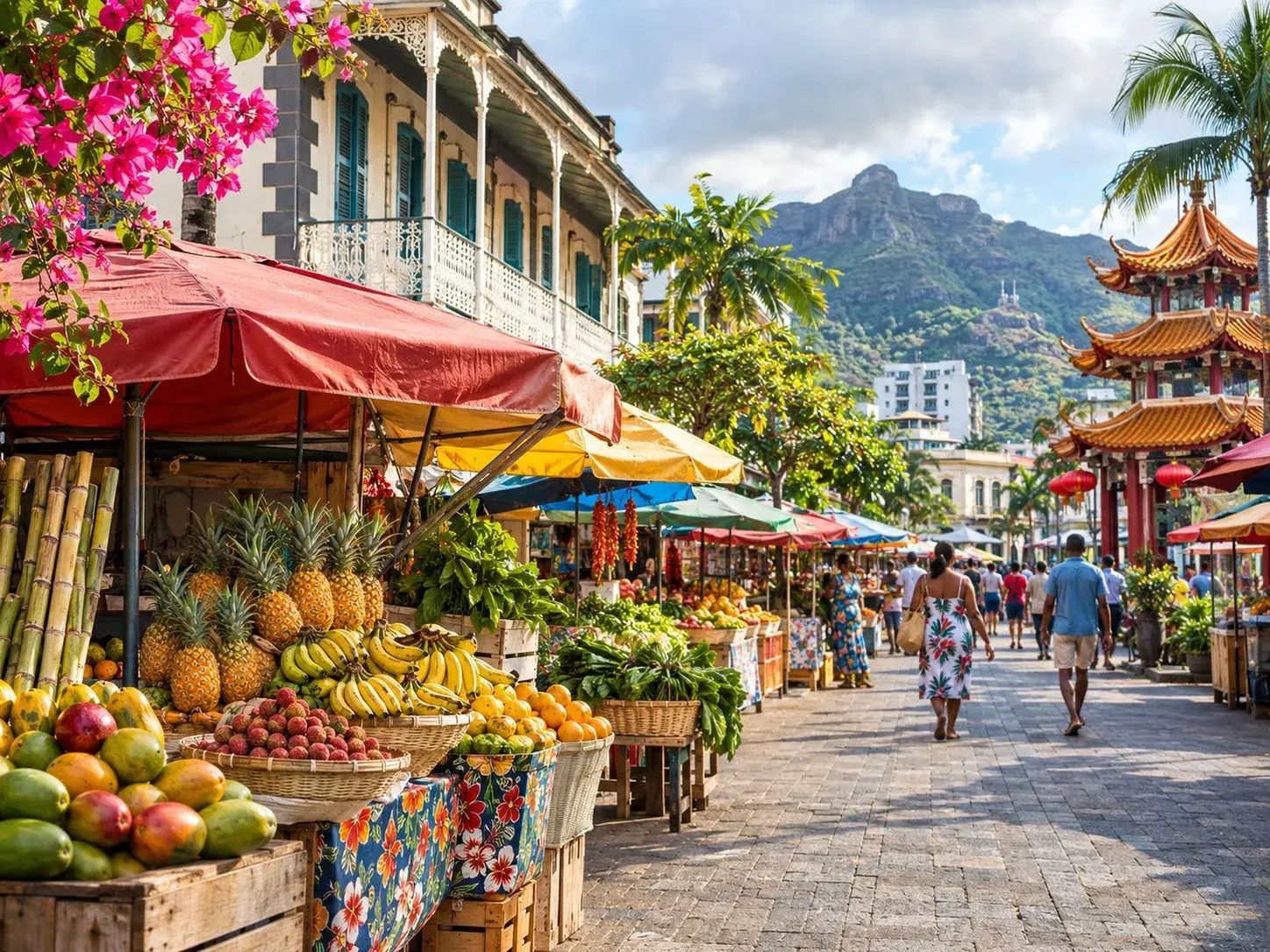
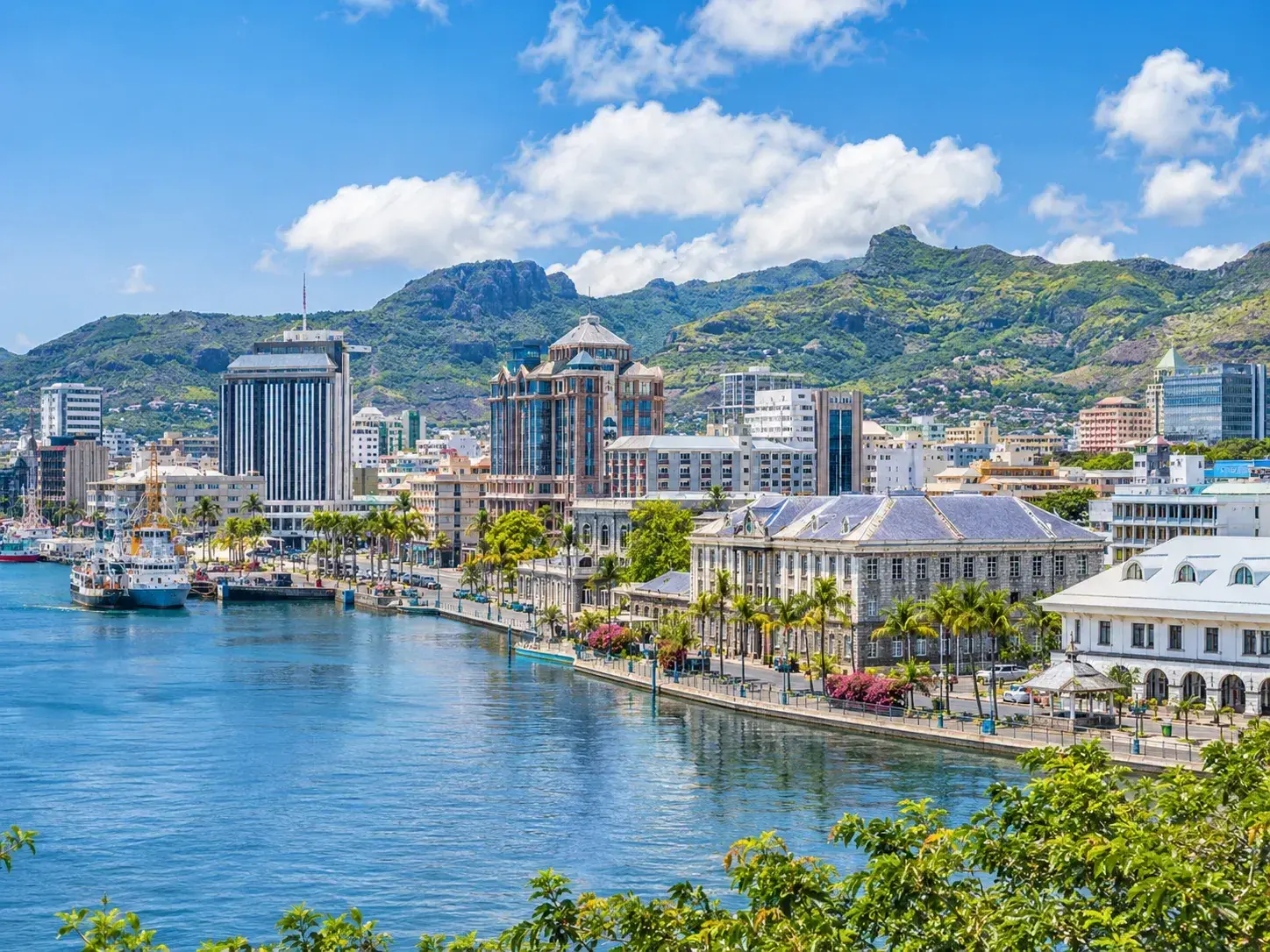
It is in Port Louis that the British century reads most clearly. The Champ de Mars, opened in 1812, is the second-oldest racecourse in the southern hemisphere. On the hill, the Citadel, or Fort Adelaide, was built from 1830 to 1840 and named after the wife of King William IV. The Central Market, opened by Governor Gomm in 1844, is the oldest in the country; its first traders came from Madras, Pondicherry and Tranquebar. The Chinese community built the Kwan Tee Pagoda in 1842. Then came the Civil Hospital in 1854, the main post office in 1870, and the Mauritius Institute building, put up from 1880 to 1884 partly on the model of the Colombo Museum. In 1933 the Granary, the port’s grain store, became the largest red-brick building in the country.
The British also defended their conquest. In the first half of the nineteenth century they built Martello towers along the coasts, round stone defensive towers intended to protect the island against the French. The one at La Preneuse, restored in 1999, is open to visitors.
 AI-generated image
Towards universal suffrage
Political life opened up slowly. A Council of Government was established in 1825; in 1886 it admitted ten members elected on a restricted franchise. In Port Louis, local democracy returned in 1850 with the first municipal elections of the British era. The Labour Party was founded in 1936 at the instigation of Dr Maurice Curé. In 1948 the vote was extended to all adults able to pass a simple literacy test, and on 9 March 1959 Mauritians voted for the first time under universal adult suffrage. The road to independence was now marked out: it led to 12 March 1968.
What can be seen today
The British century did not erase the French one: it settled on top of it. The laws and the language guaranteed in 1810 survived a hundred and fifty-eight years of English rule, and French, English and Creole are all heard today. Sugar, for its part, shaped the landscape as much as the population.
A walk through the Pamplemousses garden gives the measure of it. The château de Mon Plaisir there was entirely rebuilt in 1823 to house the garden’s director. James Duncan, appointed director in 1849, introduced bougainvillea and many palms, among them the royal palm. In 1837 the botanist Wenceslas Bojer had already brought the flamboyant tree from Madagascar. The garden, long known as the Royal Botanic Garden, has borne since 1988 the name of Sir Seewoosagur Ramgoolam, the man who led the country to independence.
Read next
- AI-generated image
Aapravasi Ghat and Le Morne: two places that explain the island
- AI-generated image
Since 1992, the Republic of Mauritius
- AI-generated image
12 March 1968, independence day
Where to stay
Stay in Mauritius
Places to stay that are still available, with current prices, compared across the main booking platforms.