
Aapravasi Ghat and Le Morne: two places that explain the island
Mauritius has two World Heritage properties: an immigration depot in Port Louis and a mountain in the south-west. Both tell the same story of forced labour, from either end.
October 31, 2026
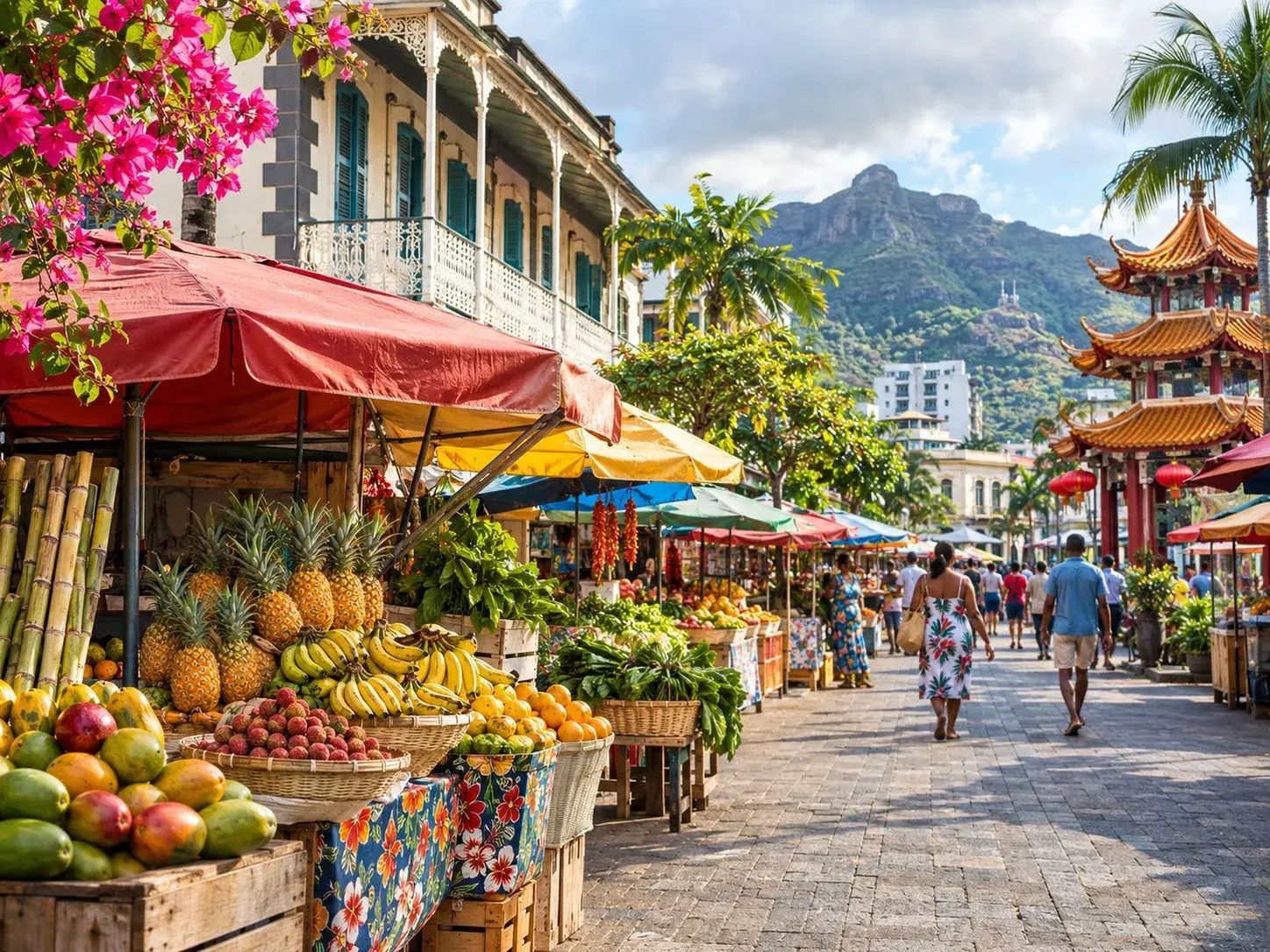 AI-generated image
A traveller who wants to understand why Mauritius looks the way it does, cane fields included, has no need of a history lesson. Two places are enough, and UNESCO has inscribed both on the World Heritage List, two years apart. The first is a quay, the second a mountain. Together they hold the two ends of the same story: that of the coerced labour that planted the island.
Aapravasi Ghat, the quay where it all arrived
The site lies on the bay of Trou Fanfaron, in Port Louis, the capital. It was inscribed in 2006 under criterion (vi), the one for places associated with events or traditions of universal significance.
What remains is modest: the ruins of an immigration depot, with the remains of the sheds that housed the immigrants, kitchens, latrines, a building used as a hospital block, and a highly symbolic flight of fourteen steps. New arrivals had to climb those fourteen steps before entering the depot.
What happened here was anything but modest. In 1834 the British government chose Mauritius as the first site of what it called the Great Experiment, intended to test free labour against enslaved labour after abolition. The success of the experiment in Mauritius led other colonial powers to adopt it from the 1840s onwards. The result was a worldwide migration of more than two million indentured labourers, of whom Mauritius received almost half.
Between 1834 and 1920, almost half a million indentured labourers from India arrived at Aapravasi Ghat, to work on the sugar plantations of Mauritius or to be sent on to Réunion, Australia, southern and eastern Africa or the Caribbean.
The history of the site itself falls into two periods. From 1834 to 1849, as immigration began and the indenture system took shape, there seems at first to have been no permanent depot. The depot was built in 1849. By 1865 it comprised offices, kitchens, an infirmary and immigrant sheds. Of all this, only the gatekeeper’s office, the infirmary and the quay steps survive: less than half the area of the 1865 depot has come down to us. The site was given the name Aapravasi Ghat in 1987.
Le Morne, the mountain where people hid
The other property is a landscape. Le Morne was inscribed in 2008 as a relict and associative cultural landscape, on the basis of criteria (iii) and (vi).
It is a mountain in the south-west of the island, a rugged peak jutting out into the Indian Ocean. It served as a refuge for runaway slaves, the maroons, throughout the eighteenth century and into the early nineteenth. Its isolated, wooded and almost inaccessible cliffs sheltered settlements in caves and on the summit.
The mountain is an exceptional testimony to maroonage, that is, to resistance to slavery: it was used as a fortress to shelter runaway slaves, and physical evidence bears witness to that use. Its dramatic form, the resistance it harboured and the oral traditions surrounding the maroons have made it the symbol of the slaves’ fight for freedom, of their suffering and of their sacrifice. Its significance reaches the African continent, Madagascar, India and South-East Asia.
The property covers 349.6 hectares, with a buffer zone of 2,405 hectares. Only the mountain is included, but its spiritual qualities extend well beyond, into its surroundings.
Life as a World Heritage site is not always peaceful. Access to the mountain only became effective in July 2016, after the State halted a development project and following a legal dispute with a developer.
Why these two places explain the landscape
Because the cane fields are not scenery. They are the reason half a million people climbed fourteen steps in Port Louis. A century earlier, they were the reason others were transported here by force, and then fled to a mountain.
A visitor who holds these two places together also understands why Creole is the language of almost every Mauritian household, and why Bhojpuri is still spoken by one person in twenty. The way the island was peopled is no accident of geography: it is a consequence of an agricultural economy.
Seeing one after the other
The two places are not visited in the same way. Aapravasi Ghat is an urban site, on the waterfront, in the heart of the capital. People come for a few walls, a flight of steps, and the dizzying thought that almost half a million lives passed through here. Le Morne is a landscape, seen from afar before it is approached, rising above the ocean in the south-west of the island.
One is looked at up close, the other first from a distance. But it takes both for the story to be complete. The quay tells how the island was peopled after abolition. The mountain tells what it was before, and what some risked to escape it.
Read next
- AI-generated image
Since 1992, the Republic of Mauritius
- AI-generated image
12 March 1968, independence day
 AI-generated image
Port Louis, a capital born of a harbour
Where to stay
Stay in Mauritius
Places to stay that are still available, with current prices, compared across the main booking platforms.