
Pamplemousses and Curepipe, two gardens to read the island by
At Pamplemousses, the oldest botanical garden in the southern hemisphere tells of Poivre’s spices, of palms and of two centuries of botany. At Curepipe, a quieter garden keeps a palm of which no other specimen exists in Mauritius.
October 16, 2026
 AI-generated image
Mauritius is an island of rare plants. Its flora numbers some 691 native species, 273 of which grow nowhere else in the world, and 80 per cent of native species are considered threatened: the International Union for Conservation of Nature ranks Mauritius as having the third most threatened island flora in the world, after Hawaii and the Canary Islands. Two gardens help to understand this wealth, and what it costs to keep it.
Pamplemousses, the intendants’ garden
The Sir Seewoosagur Ramgoolam Botanical Garden lies in the village of Pamplemousses, some ten kilometres north-east of Port Louis. Long called the Royal Botanic Garden, it has borne its present name since 18 September 1988, in memory of the country’s first Prime Minister. It is the oldest botanical garden in the southern hemisphere. It covers 33 hectares and brings together 823 species, including 80 palms, 150 medicinal plants, 60 endemic species and 27 spices.
Its history is that of the island. In 1736 Mahé de Labourdonnais, governor for a year, bought the Mon Plaisir estate and laid out a kitchen garden there for his household, for Port Louis and for passing ships; he introduced cassava there, from Brazil. The French East India Company then tried silk there, without success. The garden’s true creator was Pierre Poivre, intendant in 1767: in June 1770 he brought nutmeg and cloves from the island of Banda. Nicolas Céré, director from 1775 until his death in 1810, saw the first cloves ripen there in October 1776, and the first nutmeg in December 1778. It was from Mauritius that cloves would reach Zanzibar, in 1818. In the eighteenth century the garden served as a base for tropical experiments for the Jardin des Plantes in Paris.
This glory came at a price. Much of the work was done by enslaved people: in 1761, some fourteen enslaved people from India, Senegal, Mozambique and Madagascar worked there. Some, such as Rama, became so skilled at propagating plants that they were sent to train other gardeners in the French colonies, before being freed.
 AI-generated image
What to see
You enter through the great wrought-iron gate, first prize at the 1862 International Exhibition at the Crystal Palace, which has stood in its place since 1868. Behind the gatehouse stands a baobab planted in 1772. The Avenue Adrien d’Épinay is lined with bottle palms, endemic to Round Island, where only half a dozen remain in the wild. The Pont des Soupirs, from the French period, has the peculiarity that the Citron river flows beneath it while the water of the Riley canal passes over it.
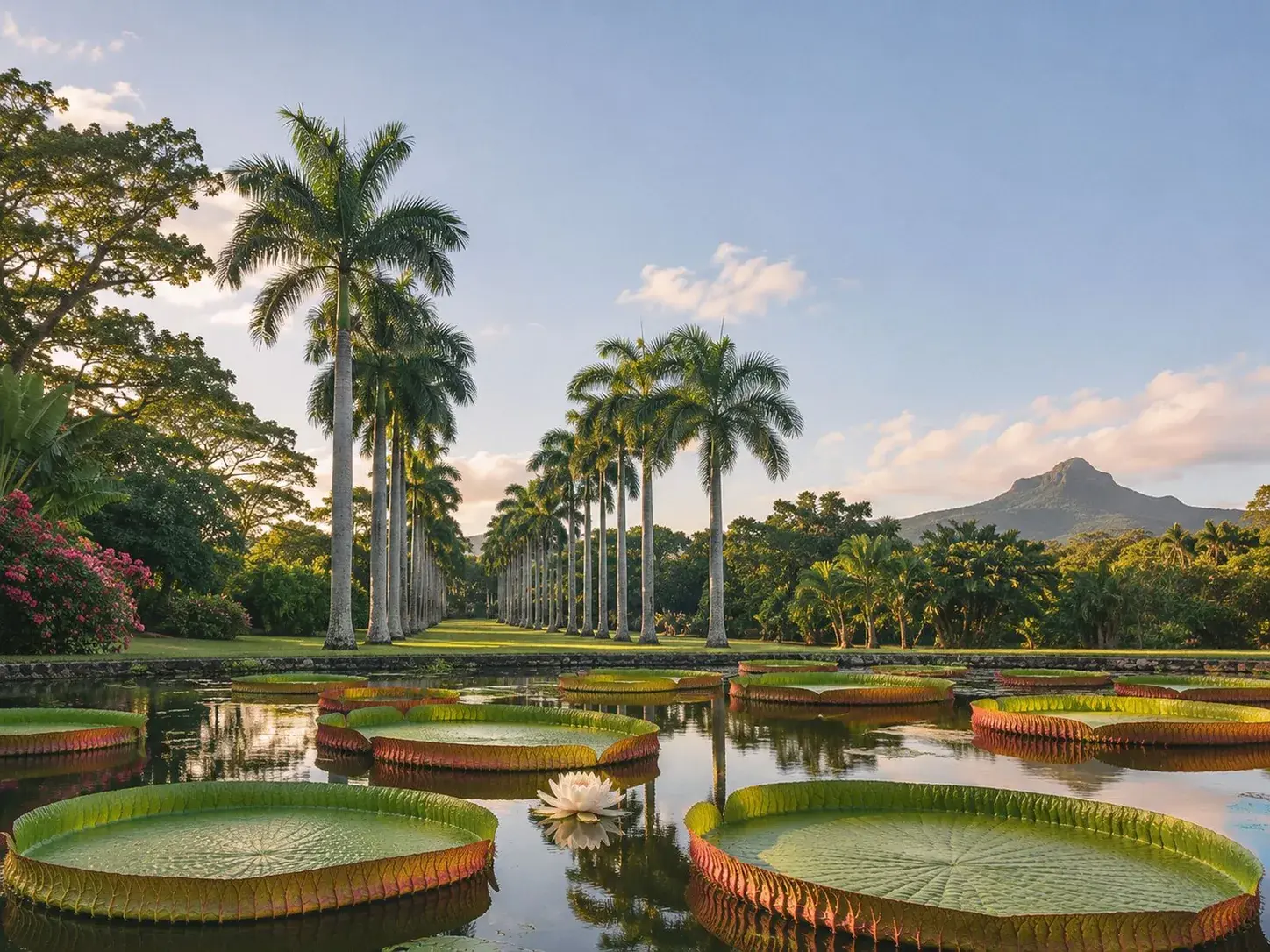
In the rectangular pond, the giant Amazon water lily opens its flowers at the end of the day, creamy white and fragrant on the first evening, pink the next. The talipot palm, introduced by the Sinhalese prince Ehelepola, exiled to Mauritius in 1825, bears the largest inflorescence in the plant kingdom and dies after setting its seeds. The Château de Mon Plaisir, built in 1823, looks towards the Moka Range and the peak of the Pieter Both. On the Liénard obelisk, a line by Bernardin de Saint-Pierre sums up the place: “The gift of a useful plant seems to me more precious than the discovery of a gold mine.”
The garden is open every day, public holidays included, from 8.30am to 5.30pm. A rehabilitation programme has been under way since January 2024.
Curepipe, the town’s garden
The Curepipe Botanical Garden extends over some 27 acres at the western end of the town, about two kilometres from the centre. The land was handed over by the government to the Curepipe Board of Commissioners in 1913 for the creation of a botanical garden. It maintains a scientific collection of exotic plants and of some of the most threatened native and endemic plants of Mauritius. Camphor trees and rhododendrons give it its character, a collection of exotic fruit trees accompanies them, and its centrepiece is a Hyophorbe amaricaulis, a palm of which the garden holds the only specimen on the island.
The main entrance is on Botanical Garden Street, at Les Casernes, with a second on Robinson Street. The garden opens from 6am to 6pm from 1 May to 30 September, and from 7am to 7pm the rest of the year. No ball games on the lawns, no picking of flowers or leaves, no cooking. It was also in Curepipe, on Robinson Road, that the government opened its native plant propagation centre in 1996, with a greenhouse, a fernery and an arboretum.
Two gardens, one lesson
Pamplemousses tells how the island received the plants of the world; Curepipe, how it is trying to keep its own. The first is visited for its history, the second for its rarities. Together they say what botany means in Mauritius: a magnificent heritage, and a rescue still under way.
To book
Things to do from this article
- Book on GetYourGuide →
Day tour by car · Port-Louis
A swim near wild dolphins, Port Louis and the botanical garden - Book on GetYourGuide →
Day tour by car · Port-Louis
Port Louis market, botanic garden and the north of the island - Book on GetYourGuide →
Day tour by car · Pamplemousses
Tour of the north: botanic garden, sugar museum and rum tasting - Book on GetYourGuide →
Day tour by car · Port-Louis
Tour of the North: Port Louis, Pamplemousses and Grand Baie
Read next
 AI-generated image
The dodo, a bird we hardly know
- AI-generated image
Black River Gorges, the last refuge
- AI-generated image
Kestrel, pink pigeon, parakeet: three birds back from the brink
Where to stay
Stay around Pamplemousses
Places to stay that are still available, with current prices, compared across the main booking platforms.