
Ebony Forest, a forest begun anew
At Chamarel, a reserve has been pulling up plants from elsewhere since 2006, to give the island’s ebonies and birds back their place. A walkway through the forest, pink pigeon aviaries, the panorama from Sublime Point: every ticket funds the work.
August 25, 2026
 AI-generated image
There are two ways of looking at a Mauritian forest. The first admires the green. The second asks which plants that green is made of, and often discovers that it belongs to Chinese guava, from Brazil, or to liane cerf, from Asia. Ebony Forest, at Chamarel, in the south-west of the island near Le Morne Brabant, teaches the second way.
Twenty years of weeding
The story begins in 2006, with Owen and Mary-Ann Griffiths and a restoration team tasked with weeding, and with tending and planting native and endemic species, often on steep and unforgiving slopes. The visitor centre opened in 2017. The conservation organisation now manages three forests; the one at Chamarel is the only one open to the public. It covers 50 hectares, of which 35 have been weeded, and 164,000 plants have been put in the ground there.
The method is stubbornly simple. In the first year, exotic trees are removed, endemic plants are propagated in the nursery and planted out, and the ground is weeded three to four times. For the next four years, the team returns to weed two to four times a year. After four years, the invaded, impoverished forest has given way to a restored forest rich in species.
The adversaries have names: liane cerf, Chinese guava, tecoma from the Caribbean, traveller’s palm from Madagascar, rose apple from the Malay Archipelago, bois d’oiseaux from Asia. And animals too: deer and pigs, kept out by fences; rats, mongooses, feral cats and tenrecs, trapped across a 50-hectare control grid.
 AI-generated image
From nursery to canopy
First comes a walk of 1.3 kilometres, fifteen to twenty minutes, to the walkway. The path runs past restoration plots at every stage, marked by stones bearing the letters RS: some freshly weeded, others just planted, others already more than three metres tall. It is the best lesson the place has to offer.
Then comes the Flycatcher walkway: some three hundred metres, more than four metres above the ground, through an old ebony forest, one of the best preserved on the island. The guided visit lasts half an hour and leaves every hour from 9.30am to 4pm, with no need to book. Here you can feel how dense ebony is, and see fruit bats hanging in the trees, Phelsuma geckos basking in the sun, the small birds known here as pic-pic, and one of the rarest trees in the world, the bois corail, named for its coral-shaped flowers. The 113 steps up and the 142 down pass almost unnoticed.
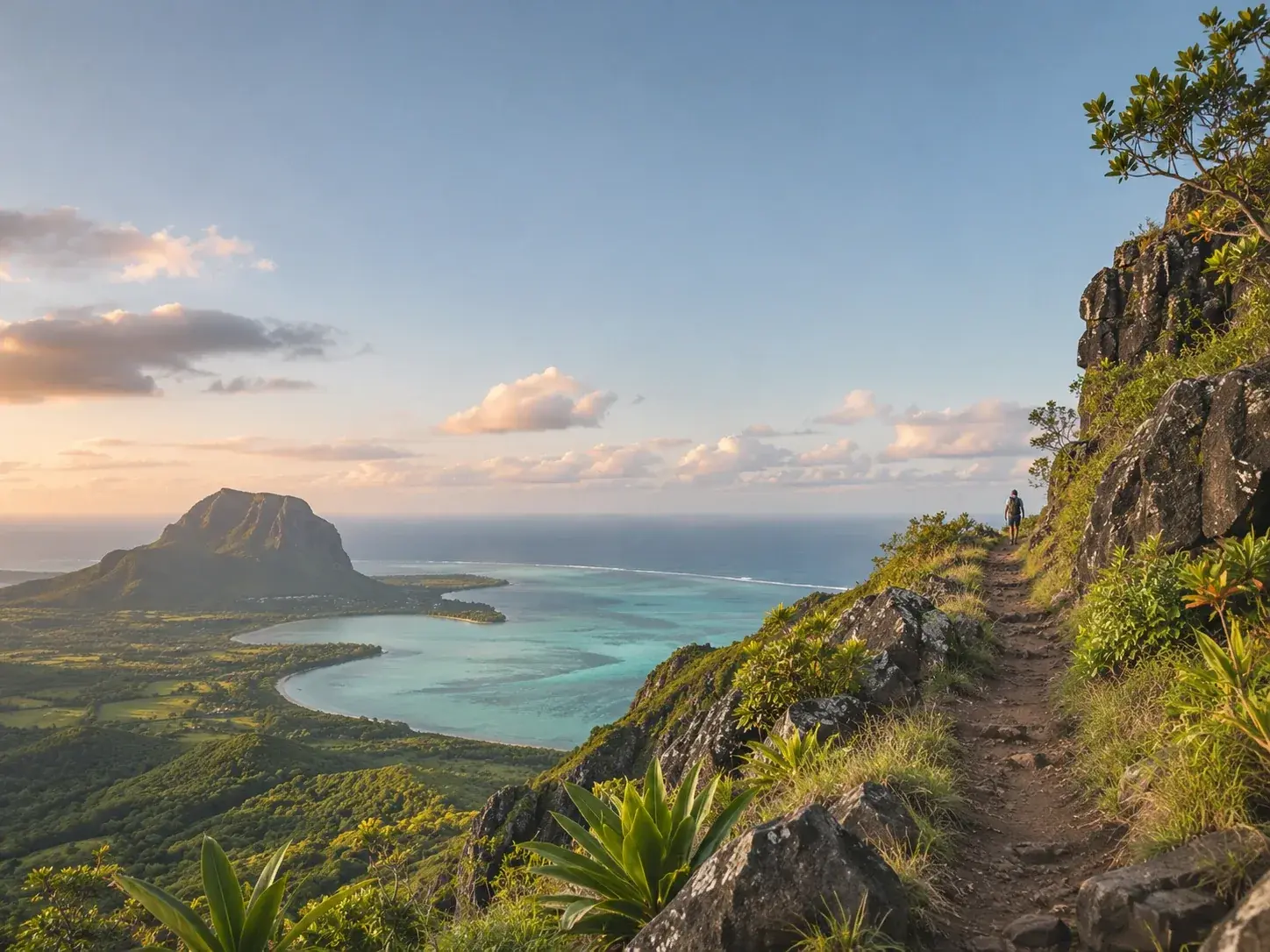
The Ridgeline Trail then leads, in 1.1 kilometres and half an hour, to Sublime Point. The coq des bois, a small Mascarene flycatcher, readily comes out to meet walkers here. The panorama takes in Le Morne Brabant, Île aux Bénitiers, the Tourelle du Tamarin, the Montagne du Rempart, the Corps de Garde, the Trois Mamelles, Le Pouce, the Pieter Both, Piton Canot and the Piton de la Rivière Noire. Below pass fruit bats, white-tailed tropicbirds, Mascarene swiftlets and, at times, the kestrel.
The most energetic climb Piton Canot: four hundred metres of trail, a hundred and forty metres of ascent, a summit at 542 metres and an all-round view of the west and south-west coasts, the village of Chamarel and Black River Gorges National Park. The path can be slippery in wet weather, and the last departure is at 4pm. The return to the visitor centre, 2.4 kilometres, takes thirty to fifty minutes, facing the valley that runs down towards Baie du Cap.
The birds that came back
What sets Ebony Forest apart from a simple walk is what has come to live there anew. The first pink pigeons were released here in February 2018; between 2018 and 2019, fifty young birds from Black River Gorges were settled here. Since 2021, the team has been hand-rearing young echo parakeets taken from the nest at 35 or 40 days old: ten were released in the 2021-2022 season, thirty-six more over the following two seasons, and eleven nest boxes have been put up in the Chamarel area. Since 2019, one or two pairs of kestrels have bred here regularly.
The birdwatching outing, three to four hours over 4.8 kilometres, usually leaves at 9am, by reservation. It alone gives access to the observation platform at the release aviaries, where pink pigeons and parakeets come to feed.
 AI-generated image
Tortoises to replace tortoises
Mauritius once had two species of giant tortoise, which dispersed seeds and grazed the vegetation. They have vanished. Ebony Forest chose to replace them with close relatives, Aldabra giant tortoises. Four young ones arrived from La Vanille in February 2019; released on 25 April 2023, they marked the first release of its kind on the main island. Ten more followed in July 2023, and another ten in June 2024. Before the trails begin, Donatello, Vanille, Ralph and Flash already keep a lawn trimmed in their own fashion.
The site closes at 5pm, and it is best to arrive before 2.30pm. Picnics are not allowed, to limit waste, and no drinks are sold in plastic bottles: a fountain refills water bottles free of charge. A natural history museum, written and illustrated by the British palaeontologist Julian Hume, and a film lasting six minutes in English or eight in French complete the visit. The profits go back into conservation.
The addresses
Places mentioned
Read next
- AI-generated image
The dodo, a bird we hardly know
- AI-generated image
Black River Gorges, the last refuge
- AI-generated image
Kestrel, pink pigeon, parakeet: three birds back from the brink
Where to stay
Stay around Chamarel
Places to stay that are still available, with current prices, compared across the main booking platforms.