Everyday island life: the clock, the holidays, the customs
Sixteen public holidays in 2027, tips left to each person’s judgement, tap water you can drink: daily life in Mauritius has its rules. Knowing them means knowing which days the island stops, and how to conduct yourself the rest of the time.
November 5, 2026
 AI-generated image
Mauritius runs on Universal Time plus four hours. That is the first adjustment to make on stepping off the plane, even before changing money or switching on your phone. The second is to look at the calendar, for the island has days of its own.
Public holidays in 2027
The calendar of public holidays says a great deal about the country. Festivals from several traditions sit side by side with two dates that tell the story of how the island was peopled: the abolition of slavery, and the arrival, after it, of indentured labourers from India. As some festivals change date from one year to the next, the list is published every year. The list for 2027, drawn up on 31 August 2026 by the Prime Minister’s Office, has sixteen days.
The year opens with two days of New Year, Friday 1 and Saturday 2 January. Then come Thaipoosam Cavadee on Friday 22 January, the Abolition of Slavery on Monday 1 February and the Chinese Spring Festival on Saturday 6 February. Maha Shivaratree falls on Saturday 6 March, Eid-ul-Fitr on Wednesday 10 March, subject to the sighting of the moon, and Independence and Republic Day on Friday 12 March. Ougadi is set for Wednesday 7 April, and Labour Day for Saturday 1 May.
Ganesh Chaturthi falls on Sunday 5 September 2027; under an amendment to the Public Holidays Act passed in 2026, Monday 6 September is a holiday in its place. The end of the year brings Divali, on Friday 29 October, All Saints’ Day on Monday 1 November and, the next day, Tuesday 2 November, the commemoration of the Arrival of Indentured Labourers. Christmas, on Saturday 25 December, closes the year.
For a traveller, these dates matter twice over. They are days off, best known before planning an errand or an appointment. They are also days of heavy crowds on the public beaches, when standby ambulances are stationed on the busiest, and when the police post lookouts on some of them.
Water, and a few ordinary precautions
You can drink the tap water: since 2012, water from the public supply has been treated to meet the drinking water standards of the World Health Organization.
Travel precautions are the same as anywhere else. Keep valuables, passport and money in the room safe, close doors and windows when going out, and report a lost room key to reception straight away. On the beach, valuables stay out of sight. The sale of tobacco products to anyone under eighteen is prohibited.
Tips, prices and markets
Tipping is not compulsory in Mauritius. It is welcome, and the amount is left to each person’s discretion. Some upmarket restaurants automatically add a service charge of 10 to 15 per cent to the bill: it is best to look at the bill before adding anything.
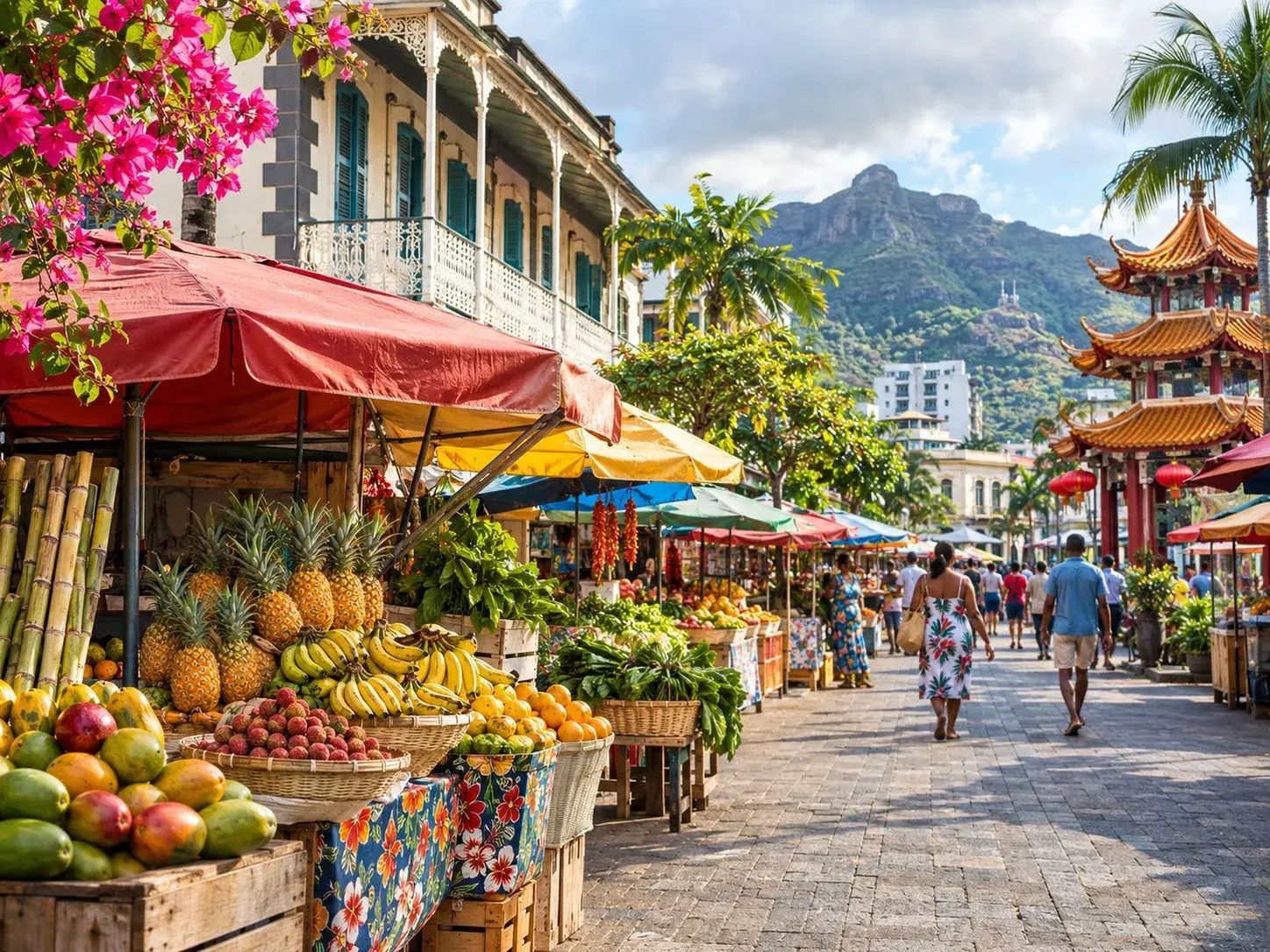
At markets, you can bargain with the stallholder, and it is well received. Everywhere else, one simple rule avoids misunderstandings: ask the price before buying, whether for an object, a taxi ride or a boat trip. On the beaches, buy no product or service from anyone not authorised to sell it, and do not hesitate to ask to see the licence of anyone offering an excursion. The Tourist Police, moreover, keep watch on touts and beach hawkers.
 AI-generated image
Everyday numbers
A few short numbers cover the essentials. The police answer on 999 or 112, the fire service on 995 or 115, the SAMU on 114. Dial 150 for directory enquiries, 152 for tourist information, 171 for the weather and 96 for cyclone bulletins. From abroad, the country code is +230.
To make a complaint, go to the nearest police station, where the officer on duty is required to take the statement, even if the matter falls to another station: the officer then passes it on to the station concerned. The island has 56 police station districts.
In case of difficulty, the Tourist Police have offices in each of the island’s six divisions, from Port Louis to Grand Baie, from La Gaulette to Blue Bay, from Belle Mare to Plaine Champagne. Created in 2003, the unit is responsible for the safety of visitors and for following up the complaints they make, keeping those concerned informed until the matter is settled.
Read next
 AI-generated image
When to go to Mauritius: an island of two seasons
- AI-generated image
Cyclones: reading the four warning classes
- AI-generated image
Two ways to travel, two budgets
Where to stay
Stay in Mauritius
Places to stay that are still available, with current prices, compared across the main booking platforms.